How Animal Communication Works: My Conversation With Joey
Aug 13, 2026
How Animal Communication Works: My Conversation With Joey
If you read Joey’s first story, you know he was suddenly terrified of a bedroom in his home—and what he eventually showed me was something no one expected. Many of you asked what happened next.
But there’s another part of Joey’s story I want to show you: how he told me what was frightening him in the first place.
When Joey's mom first contacted me, his behavior had suddenly changed.
At bedtime, this normally happy dog didn't want to enter the back bedroom. He whined and would shake uncontrollably once he was there.
During our remote animal communication session, I asked Joey what was frightening him.
He told me there was something in the bedroom.
As I continued asking questions, he showed me a shadowy male presence in the corner.
I knew nothing about the history of the house.
So I asked his mom whether anyone else in the family had ever experienced anything unusual there.
At first, she said no.
Then there was silence.
She was remembering.
Years earlier, her son had refused to go near that same side of the house because he said he'd seen a "shadow man."
That's when what Joey had communicated took on an entirely different significance.
I wasn't interested in proving exactly what the presence was.
What mattered was that Joey was experiencing something that frightened him—and he had found a way to tell us.
I was able to clear away, using shamanic healing techniques, the "shadow man" from the home to put Joey at ease again.
How Did Joey Communicate This to Me?
This is where Joey's story gives us a wonderful example of how animal communication really works.
Joey and I were having a conversation.
I asked a question.
He answered.
His answer led me to another question.
And he gave me more information.
Animal communication can be much more conversational than people realize.
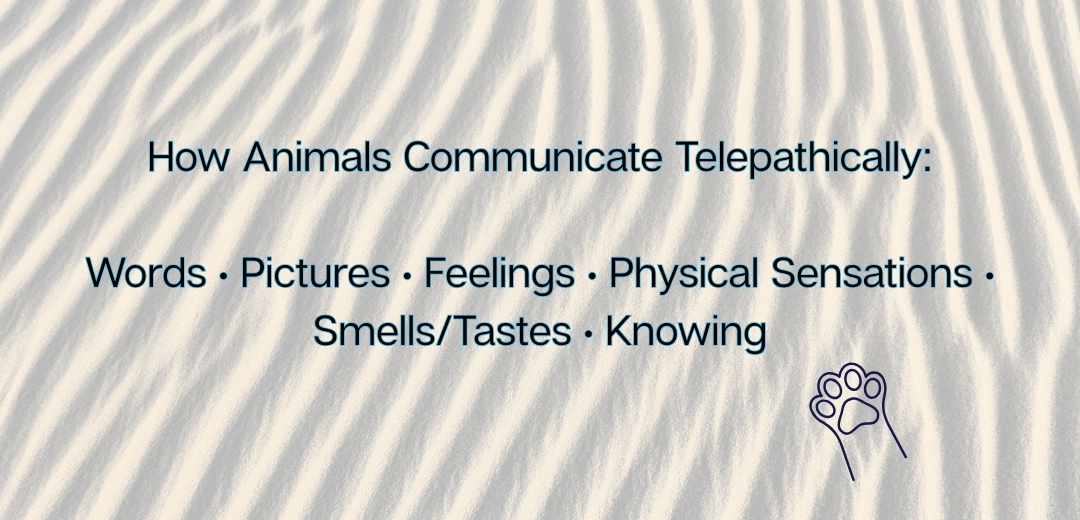
The difference is that animals don't need spoken language to communicate with us telepathically.
Their answers may come through as:
- a word or phrase
- a picture or scene in your mind
- an emotion
- a physical sensation
- a smell or taste
- or a sudden sense of simply knowing
In Joey's case, some of the communication was very direct: there was something in the bedroom, I heard him say.
As I continued the conversation, he gave me more.
And that's where something else becomes incredibly important.
We have to be willing to listen to what the animal actually gives us—not what we expect them to say.
The Hardest Part of Animal Communication: Trusting What You Receive
Imagine receiving an image of a shadowy man while communicating with a dog.
Your logical mind might immediately jump in:
That's weird.
Where did THAT come from?
I'm making this up.
And the communication could end right there.
This is one of the biggest struggles I see when people are learning animal communication.
They receive something...
and then immediately talk themselves out of it.
Sometimes the challenge isn't receiving the information at all.
It's trusting it long enough to stay curious.
What was important in my conversation with Joey wasn't that I immediately understood what he was showing me.
I didn't.
It was that I didn't dismiss it simply because it was unexpected.
I kept listening.
And eventually, his mom remembered something I couldn't possibly have known.
To resolve it, I was able to clear away, using shamanic healing techniques, the "shadow man" from the home to put Joey at ease again.
Your Animal May Already Be Talking to You
Joey's story is certainly unusual.
But the way he communicated isn't.
Our animals may send us information much more quietly every day.
You may suddenly picture something while thinking about your animal.
A word may pop into your head.
You may feel an emotion that doesn't seem to be yours.
You might experience a physical sensation.
Or you may simply know something without knowing why you know it.
And because it happens so naturally, it's incredibly easy to think:
"That was just me."
But what if it wasn't?
Try This Simple Animal Communication Exercise
Find a quiet moment with your animal and ask one simple question:
"What would you like me to know right now?"
Then don't try to make an answer happen.
Just notice what comes first.
A picture?
A word?
A feeling?
A sensation?
A thought that seems to come from nowhere?
Don't analyze it yet.
Simply notice it.
Because the analytical mind tends to arrive next with all sorts of reasons why what you just received couldn't possibly be right.
This Is How Animal Communication Begins
When people first learn animal communication, they sometimes think the goal is to somehow get their animal to start talking to them.
But often, that's not where we begin.
We begin by learning how to listen.
Joey and I had a conversation. I asked a question. He answered. I asked another question. And little by little, he gave me the information I needed to better understand what he was experiencing.
Was Joey's message unusual? Absolutely.
But the way we communicated wasn't.
This is how animal communication can work.
You ask. You receive. You stay curious. You ask more.
And perhaps the hardest part of all?
You trust what you receive long enough to keep the conversation going.
That's a skill you can develop.
So when you try the exercise above with your own animal, don't worry about whether you're "doing it right."
For now, just listen.
Because that little picture, feeling, word or knowing that arrives before you have time to think about it?
It just might be the beginning of a conversation.
If you haven't read the beginning of Joey's story and how we discovered what was frightening him, you can read Part 1 here
Want to learn more about Animal Communication or have your own private reading? You can explore more here